

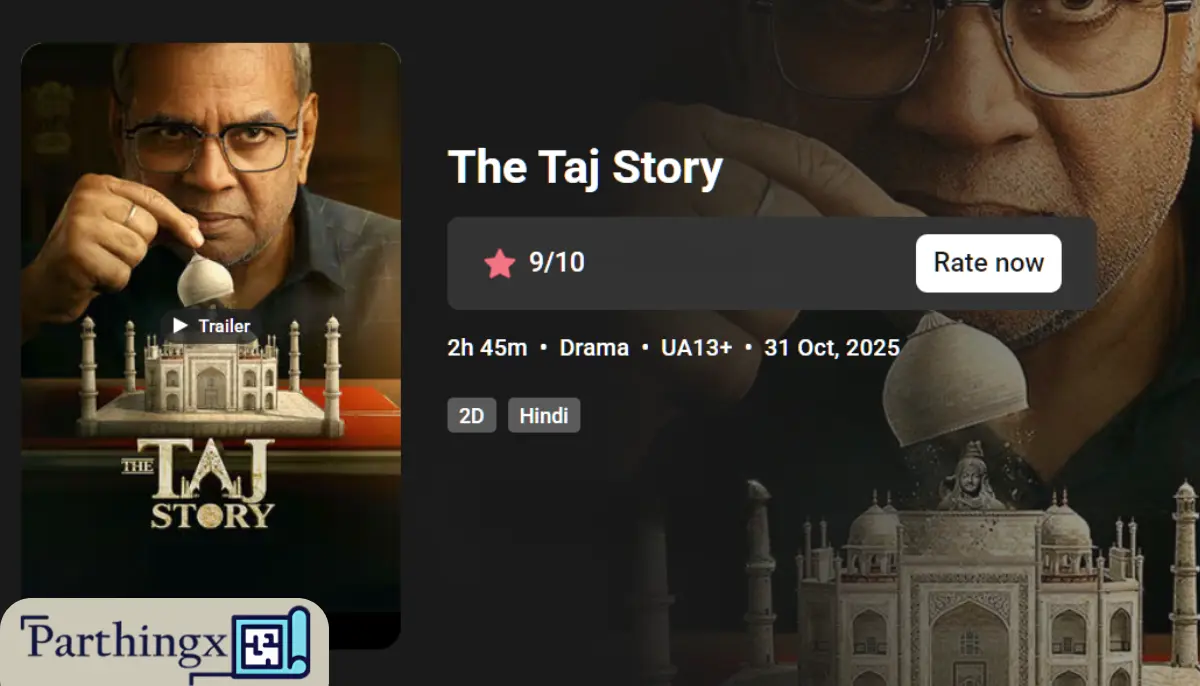
Release Date: October 31, 2025
Genre: Drama, Courtroom Thriller
Runtime: 2h 45m
Cast: Paresh Rawal, Zakir Hussain, Namit Das
Rating: 9/10 (Average Critic Score)
“The Taj Story,” starring the veteran actor Paresh Rawal, has sparked massive debate across social media and cinema halls since its release. The film tackles one of the most sensitive and controversial topics in Indian history: Is the Taj Mahal actually a tomb built by Shah Jahan, or was it originally an ancient Hindu temple named Tejo Mahalaya?
While the movie promises to uncover “hidden truths,” reviewers are divided. Is it a brave exploration of history, or just a dramatic fiction based on internet theories? Here is an in-depth review based on critical analysis.
The Plot: What is the Movie About?
The story revolves around Vishnudas (played by Paresh Rawal), a senior tour guide at the Taj Mahal in Agra who has served there for 25 years. Vishnudas is a man of conviction who believes that the history taught in textbooks is incorrect.
Conflict arises when a video of Vishnudas goes viral. In the video, he claims the Taj Mahal is a Hindu temple. This leads to public outrage, he is humiliated (blackened face), and loses his job. Determined to prove his truth, Vishnudas takes the matter to the High Court. The rest of the film is a courtroom drama where he fights against the state’s lawyers to prove that the Taj Mahal predates the Mughals.
In-Depth Analysis
1. Performance: The Paresh Rawal Show
Across all reviews, one thing is unanimous: Paresh Rawal is brilliant.
-
He carries the entire film on his shoulders. His portrayal of a helpless yet determined common man fighting the system reminds the audience of his powerful performance in OMG: Oh My God!.
-
His dialogue delivery in the courtroom scenes is intense and engaging.
-
Supporting actors like Zakir Hussain (the opposing lawyer) provide good support, though some reviewers felt the side characters were a bit melodramatic.
2. Script and Pacing: A Tale of Two Halves
The movie suffers from pacing issues:
-
First Half: The build-up is strong. The movie successfully establishes the tension, the controversy, and Vishnudas’s personal stakes. It hooks the audience effectively.
-
Second Half: The movie drags significantly after the interval. The courtroom scenes become repetitive (“Tareekh pe Tareekh”). Reviewers noted that the film, at 2 hours and 45 minutes, is far too long and could have been easily trimmed by 30 minutes.
3. Historical Accuracy vs. “WhatsApp University”
This is where the movie faces its harshest criticism.
-
Lack of Evidence: Critics, particularly historians, point out that the movie relies heavily on debunked theories (similar to those by P.N. Oak) rather than actual archaeological evidence. The film presents claims often seen in WhatsApp forwards as “facts.”
-
Logical Flaws: There are scenes that defy scientific logic. For example, a fictional foreign archaeologist is shown picking up a sample for carbon dating with his bare hands—a huge error in archaeology, as samples must be handled with gloves to avoid contamination.
-
Fictional Historians: Since there is no concrete historical proof for the temple theory, the movie invents fictional archaeologists and books to support its narrative, rather than citing real academic sources.
4. The “Villain” Stereotype
The film has been criticized for its portrayal of the opposing side. The characters opposing Vishnudas are often shown using heavy stereotypes—wearing eyeliner (surma), eating kebabs constantly, and using menacing Urdu dialogues. Critics argue this reduces complex historical debates into a black-and-white “Hero vs. Villain” narrative that can feel manipulative.
Final Verdict: Should You Watch It?
Watch it if:
-
You are a die-hard fan of Paresh Rawal and enjoy powerful acting performances.
-
You enjoy courtroom dramas and don’t mind a slower pace.
-
You are interested in the pop-culture debate surrounding the Taj Mahal and want to see a dramatic representation of it.
Skip it if:
-
You are looking for a factual, historically accurate documentary.
-
You get easily bored by long, repetitive dialogue-heavy scenes.
-
You prefer movies that rely on logic and science rather than emotional arguments.
Conclusion
“The Taj Story” is a well-acted drama that plays on current political and social sentiments. While it succeeds as an emotional story of one man’s fight, it fails as a lesson in history. It is best enjoyed as a work of fiction rather than a revelation of truth.
Rating: ⭐ (9/10)